
Deep Retrofit & Barn Conversion of Owlet House, Dore
Transforming a Damp 19th-Century Farmhouse into a Fossil-Fuel-Free Family Home
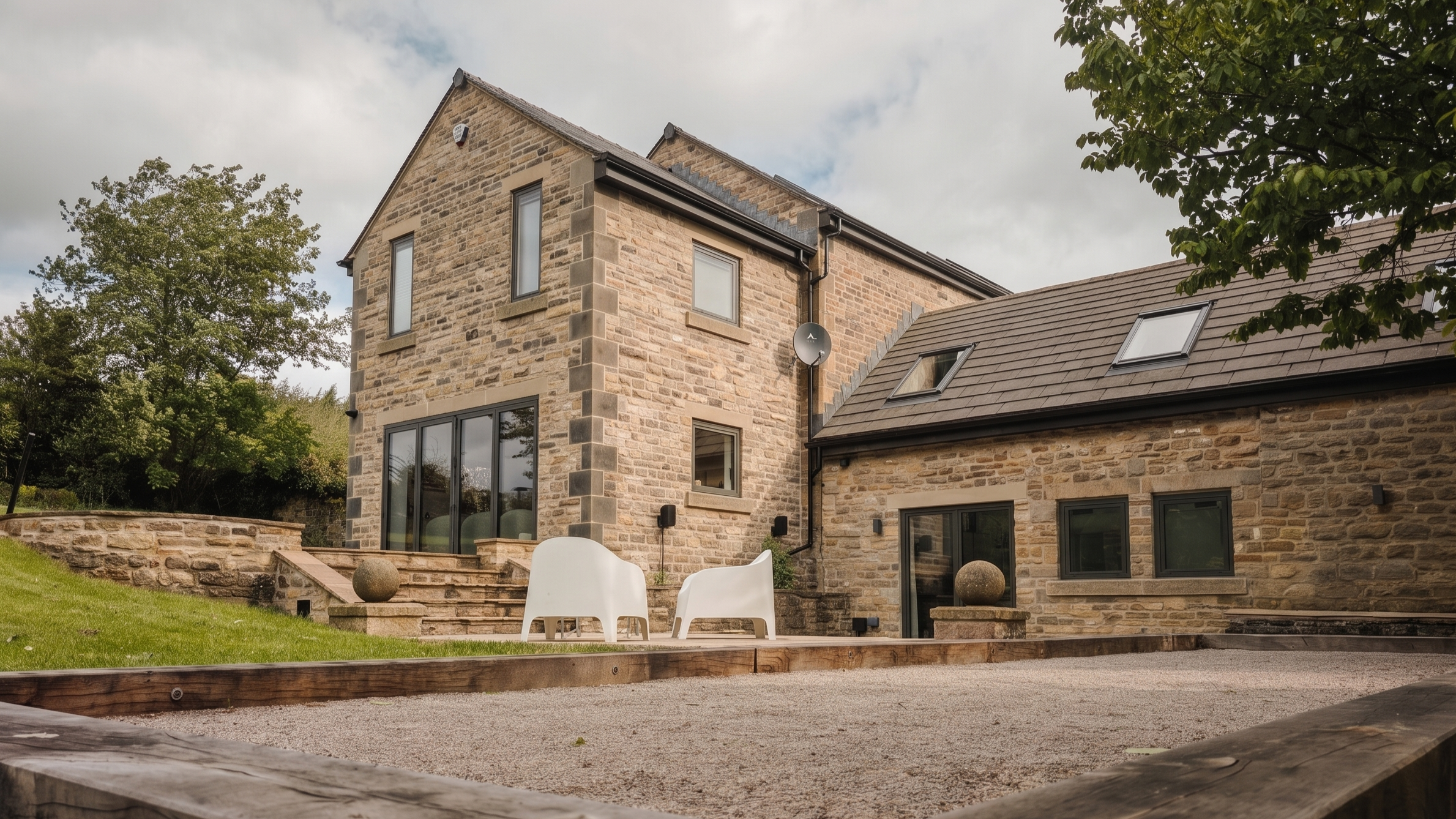
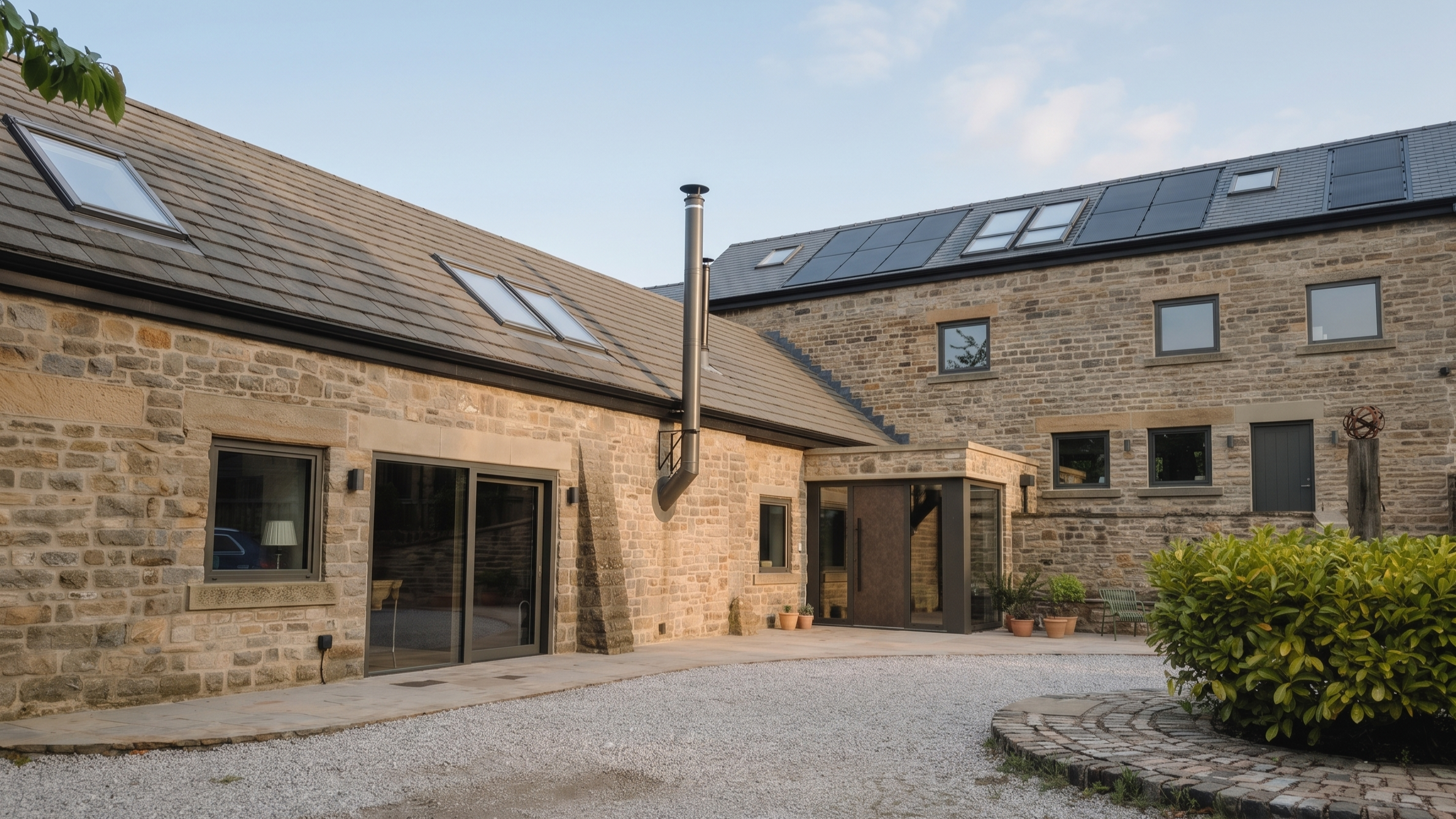
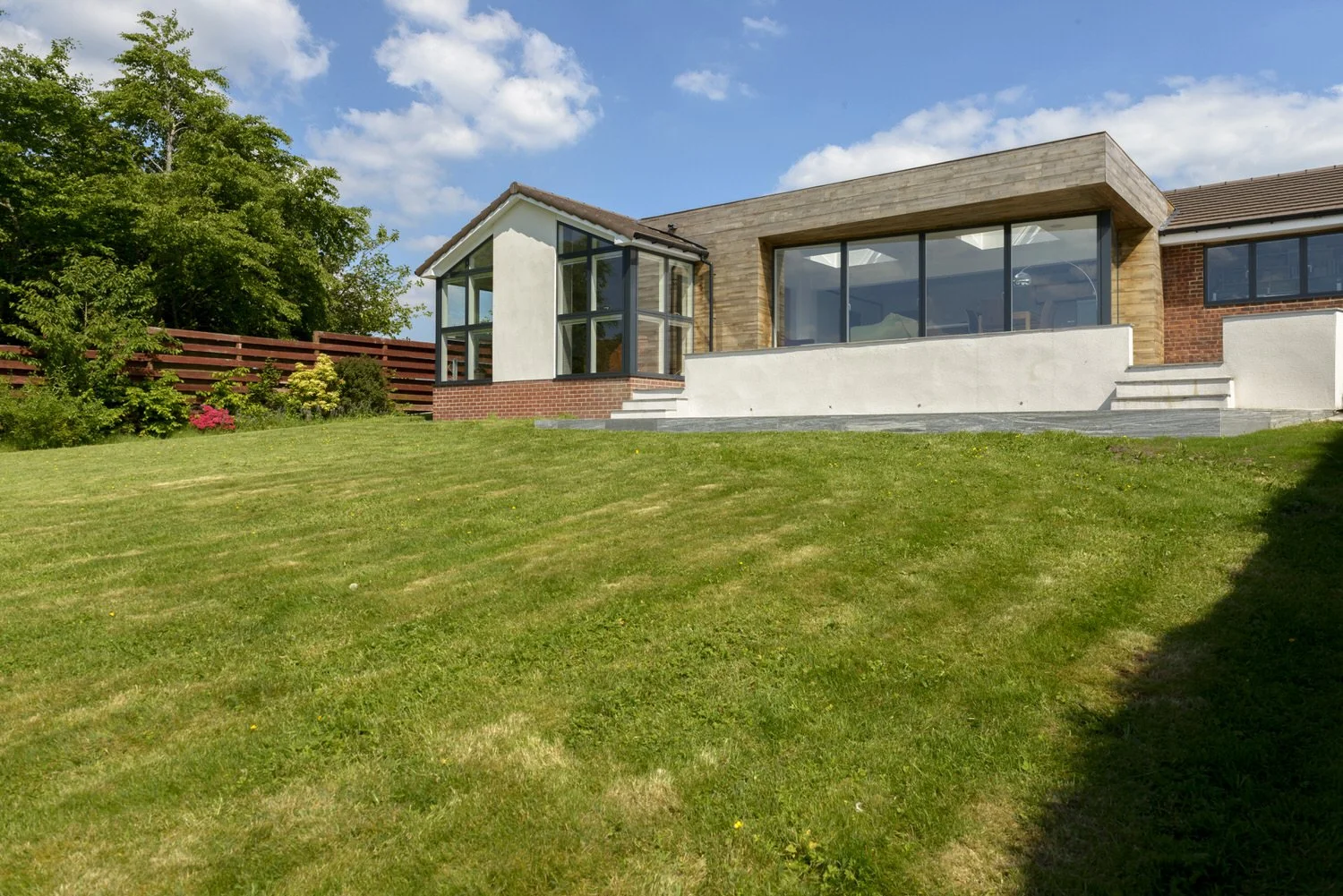
MAD Architects transformed a nineteenth-century farmhouse in Dore Moors into a modern, energy-efficient family home. The project combined sensitive restoration of the original stone building with a fabric-first retrofit strategy, renewable technologies, and a new open-plan extension designed to maximise views across the Peak District.
A Family Farmhouse Reimagined for the Next Generation
When the owners took over Owlet House from their parents, they faced a difficult choice. The farmhouse held decades of family memories, but years of damp, structural deterioration and dependence on oil heating had made year-round living increasingly uncomfortable. Rather than leaving the land, they chose to invest in a deep retrofit that would preserve the building's historic character while preparing it for another generation of family life.
| Project Detail | |
|---|---|
| Location | Hathersage Road, Moors above Dore, Sheffield |
| Property Type | 19th-Century Farmhouse & Barn Conversion |
| Planning Status | Sheffield City Council Approved • Green Belt & Dore Neighbourhood Plan |
| Architect | MAD Architects LLP |
| Structural Engineer | White Structures Ltd |
| Main Contractor | Steve Bridges Building & Joinery |
| Heating & MVHR | Matrix Energy Systems Ltd |
| Kitchen Design | Russell & Hutton |
| Lighting Design | David Village Lighting Ltd |
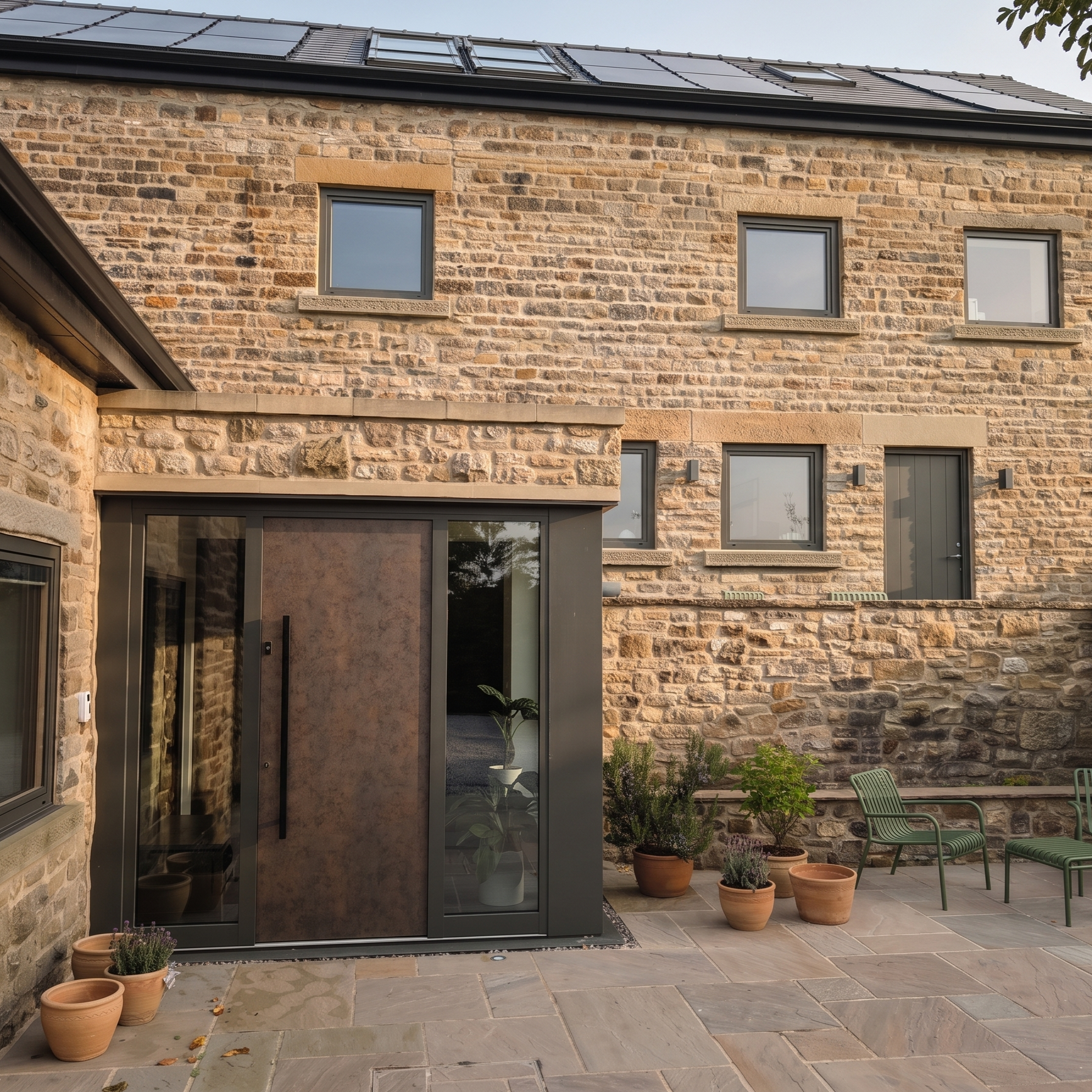
| External Glazing | ecoHaus SW Ltd • Internorm |
| Key Challenges | Wet Rot in Roof, Substantial 1.2m Floor Split, & Severe Moorland Weather |
| Key Materials | Traditional Gritstone, 150mm Breathable Hempcrete, Internorm Triple Glazing |
| Carbon Reduction | 75.75% Estimated Reduction (Moved completely off heating oil/fossil fuels) |
| Heating Efficiency | 72% Space Heating Demand Reduction (Insulation-first, breathable hempcrete approach) |
Tackling the Chill:
Restoring Comfort to the High Moors
Sitting on the wind-swept moorland above Dore, Owlet House has weathered Peak District winters for nearly two centuries. But by the time we began our site analysis, the solid gritstone building was losing the battle against the elements. A well-intentioned but flawed 1980s renovation had lined the historic walls with non-breathable gypsum plaster and cement. This trapped moisture inside the solid stone masonry, causing the internal finishes to crumble, while uninsulated walls and cold drafts left the family huddled around an expensive, high-maintenance oil boiler and an old oil-fired AGA.
To transform this damp shell into a warm, energy-efficient lifetime home, we had to rethink the building from the inside out.
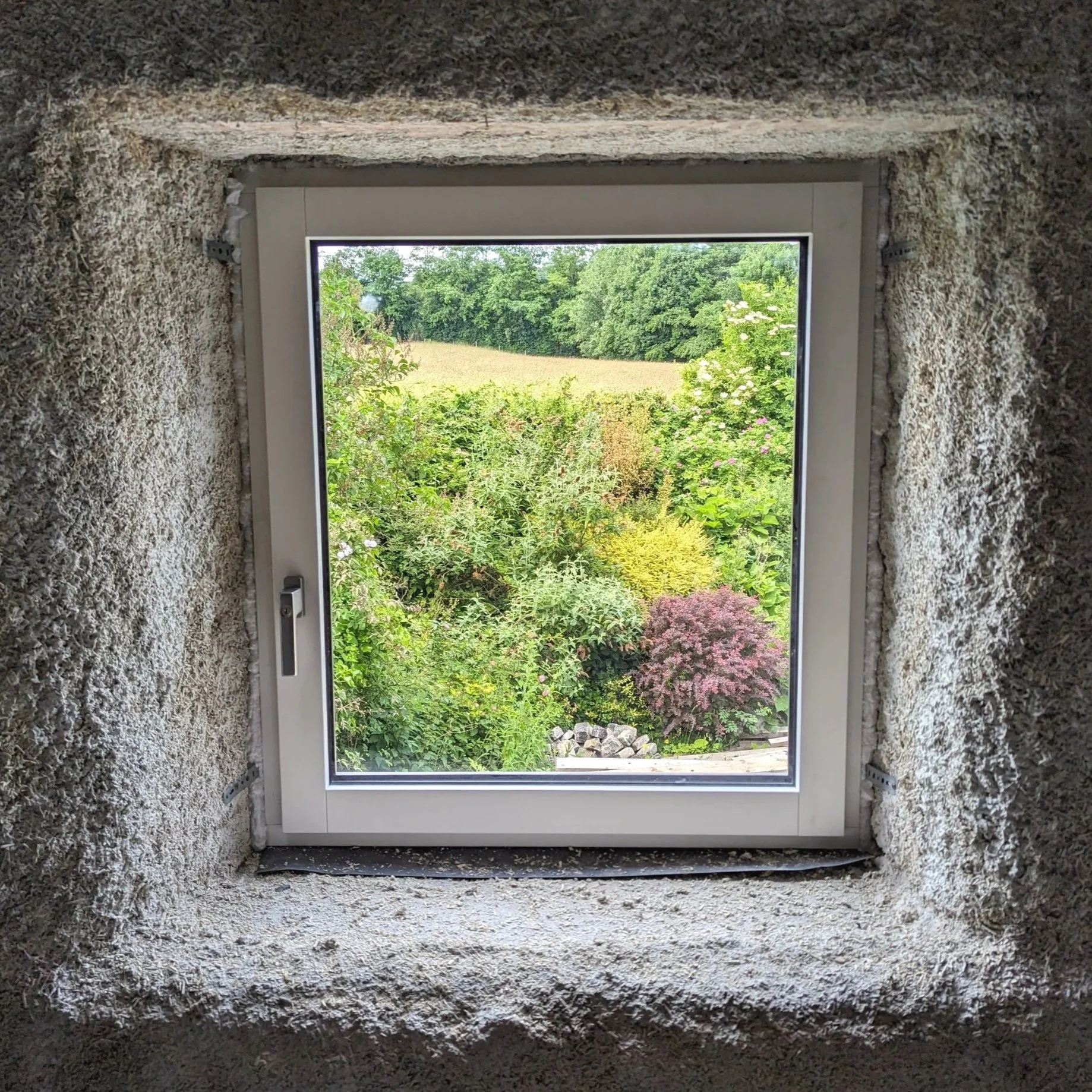
Instead of fighting the historic fabric, we embraced it. Our deep retrofit approach stripped away the failing 1980s linings and replaced them with a 150mm layer of natural, spray-applied hempcrete. Formulated from hemp shiv and lime, this breathable insulation acts like a high-performance winter coat. It lets moisture move naturally through the gritstone walls while raising the home's thermal resistance (achieving a U-value of 0.34 to 0.40 W/m²K)—meaning the walls are now completely dry and warm to the touch.
With the building's thermal envelope secured, we replaced the volatile, carbon-intensive oil heating with a silent geothermal ground source heat pump (GSHP) engineered by Matrix Energy Systems Ltd. Fed by five kilometers of underground loops buried in the adjacent pasture, this low-temperature system feeds a comfortable underfloor radiant network.
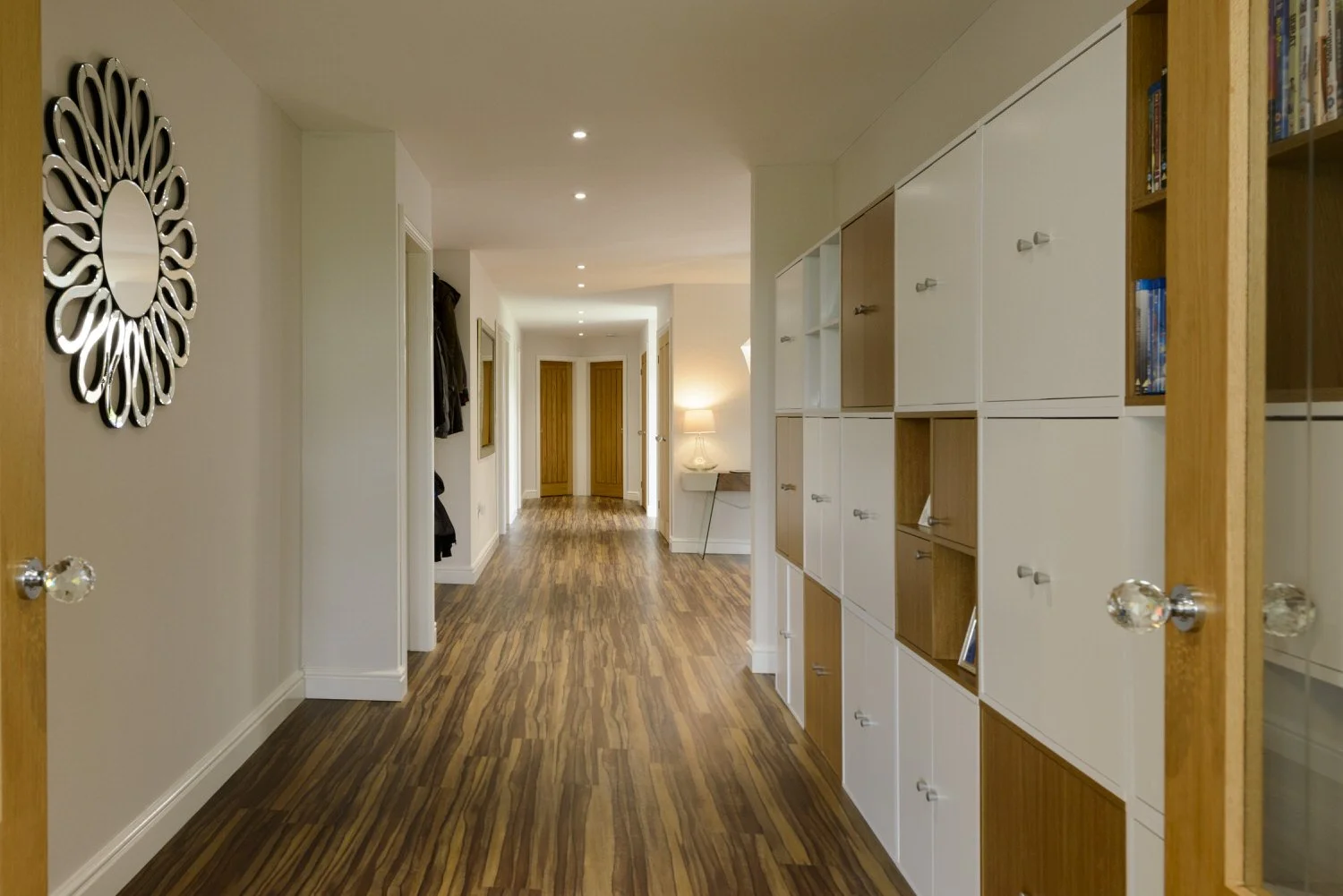
To complete the layout, we opened up the cold, dark core of the original barn. By exchanging the outdated oil system for a clean, electric model, we transformed the old agricultural space into a warm, inviting social hub.
The open-plan kitchen, designed in partnership with Russell & Hutton, now flows effortlessly across the historic floors, unified by a careful lighting scheme from David Village Lighting Ltd featuring delicate clusters above the kitchen island and minimalist architectural profiles flush-mounted into the vaulted ceilings to provide seamless, ambient illumination.
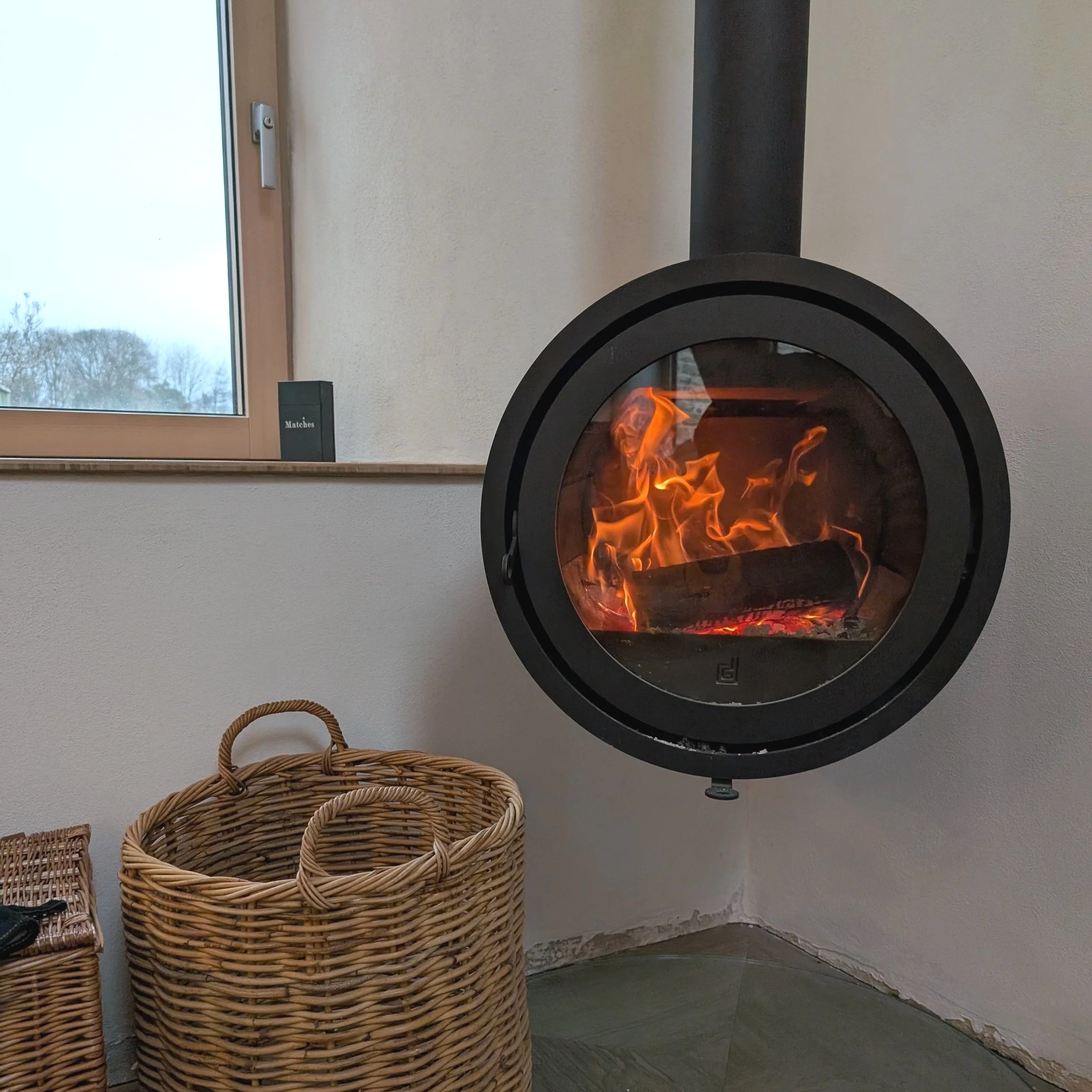
To balance this quiet, modern efficiency with traditional tactile warmth, we introduced two striking fire elements. The primary vaulted living room centers around a dramatic, ceiling-hung suspended wood-burning stove, while a cozy, flush-fitting inset stove warms the quiet family snug.
Planning & Ecology:
Working with the Peak District Landscape
Building in the Green Belt and within the Dore Neighbourhood Plan Area requires a delicate balancing act. Sheffield City Council enforces strict limits on rural development—specifically capping new residential extensions at one-third (33.3%) of the original building's volume.
Our strategy was to focus on spatial intelligence rather than sheer footprint. We kept our physical extension minimal, looking instead to the surrounding landscape to solve our largest structural and ecological challenges.
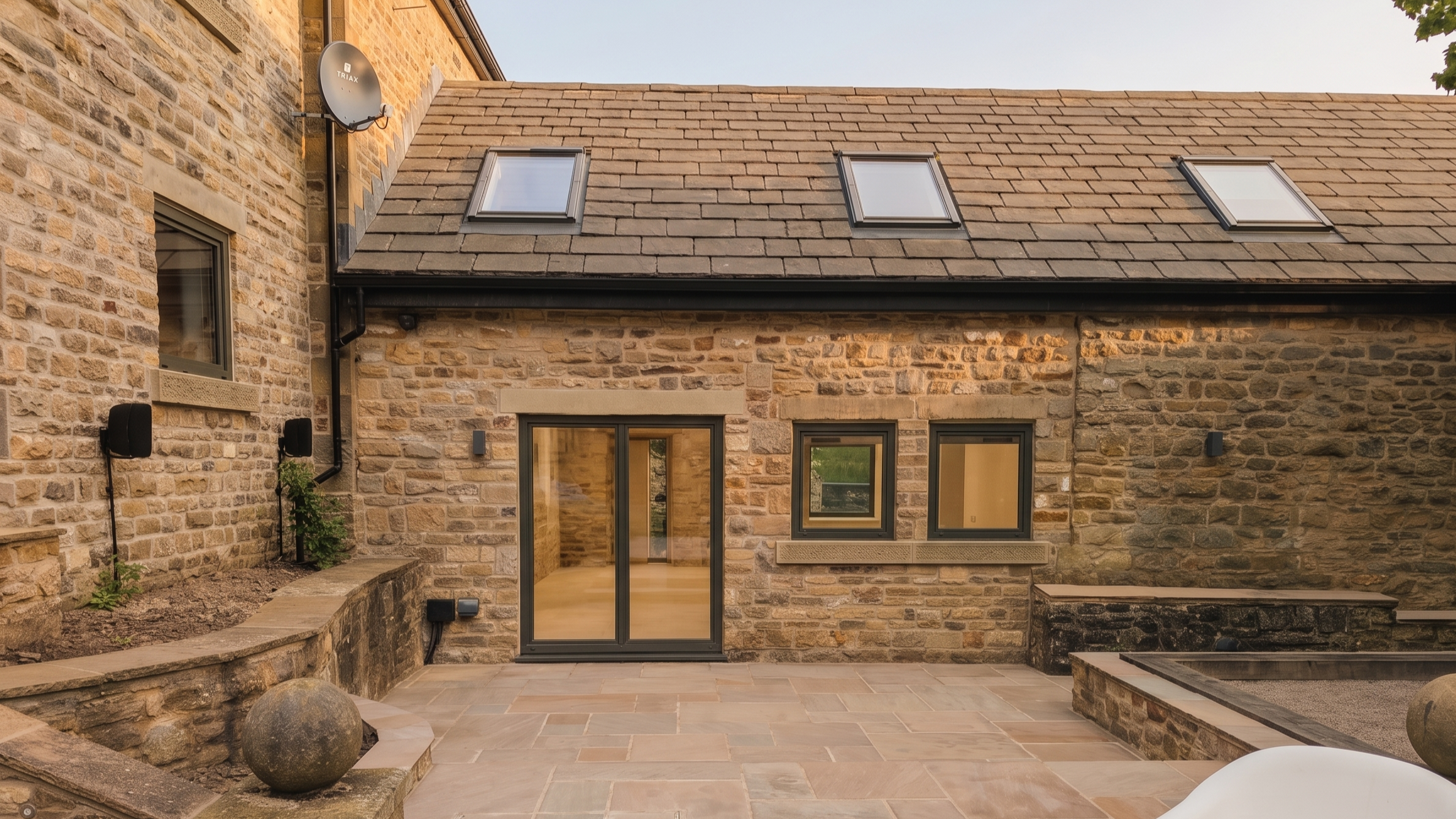
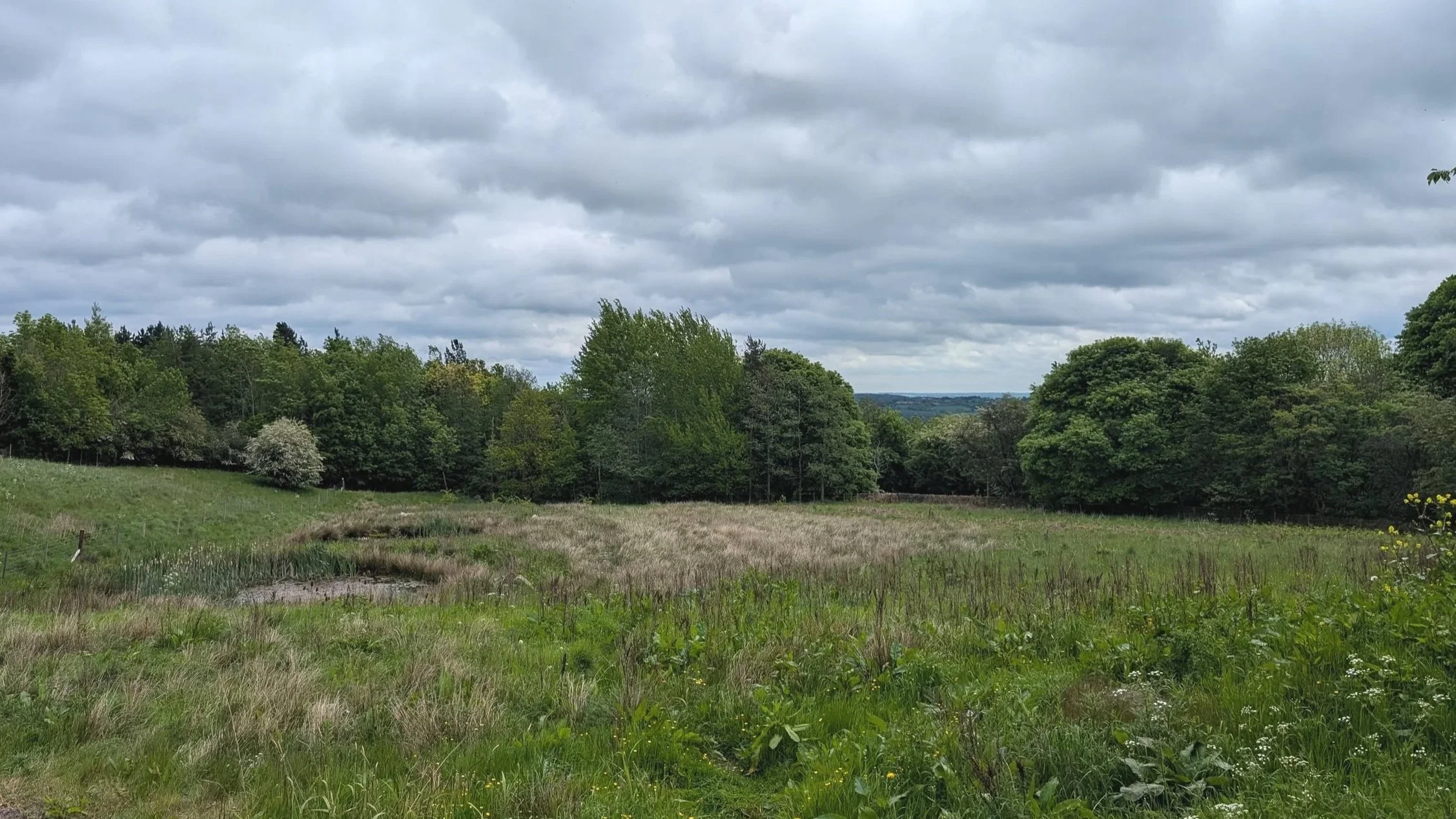
The massive excavation required for the five-kilometer ground-loop heating field could have left the site looking scarred. Instead, we collaborated with ecological consultants Wildscapes to turn the installation into a biodiversity victory. Wildscapes graded and restored the pasture with a native Peak District wildflower and grass seed mix, allowing the ground-loop field to blend seamlessly back into the hillside.
To manage heavy wind-driven moorland rain, we designed a natural, gravity-fed Sustainable Drainage System (SuDS). Wildscapes profiled two new wildlife ponds on the site, using native wetland plants naturally deals with the stormwater runoff.
Visualizing the Solution:
Solving the Split-Level Puzzle
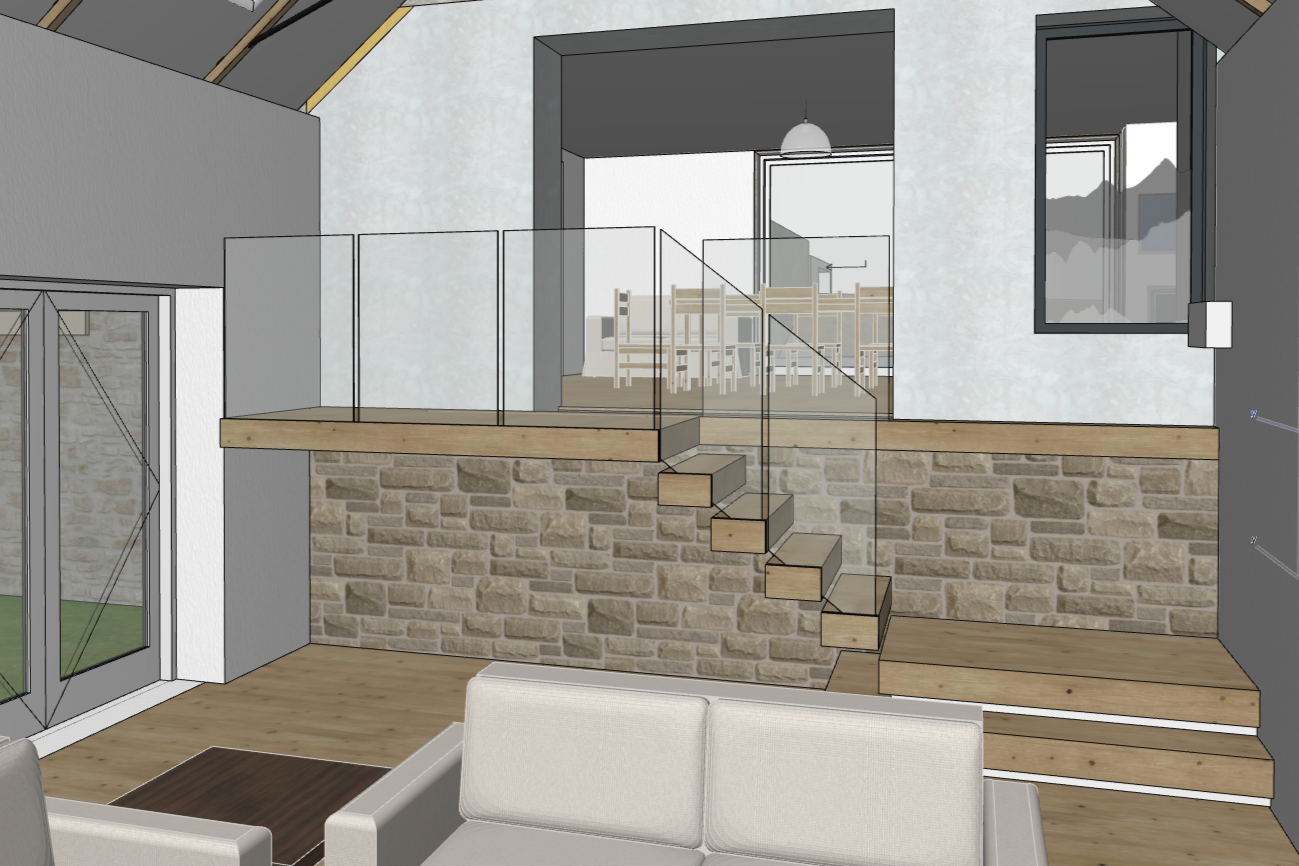
One of the greatest functional barriers inside Owlet House was an awkward 1.2m floor height difference between the original barn and the main farmhouse. Historically, this split level kept the two halves of the building entirely isolated.
Using ArchiCAD and 3D BIM modelling, we resolved this puzzle by introducing two distinct staircase elements that served very different spatial, structural, and safety roles.
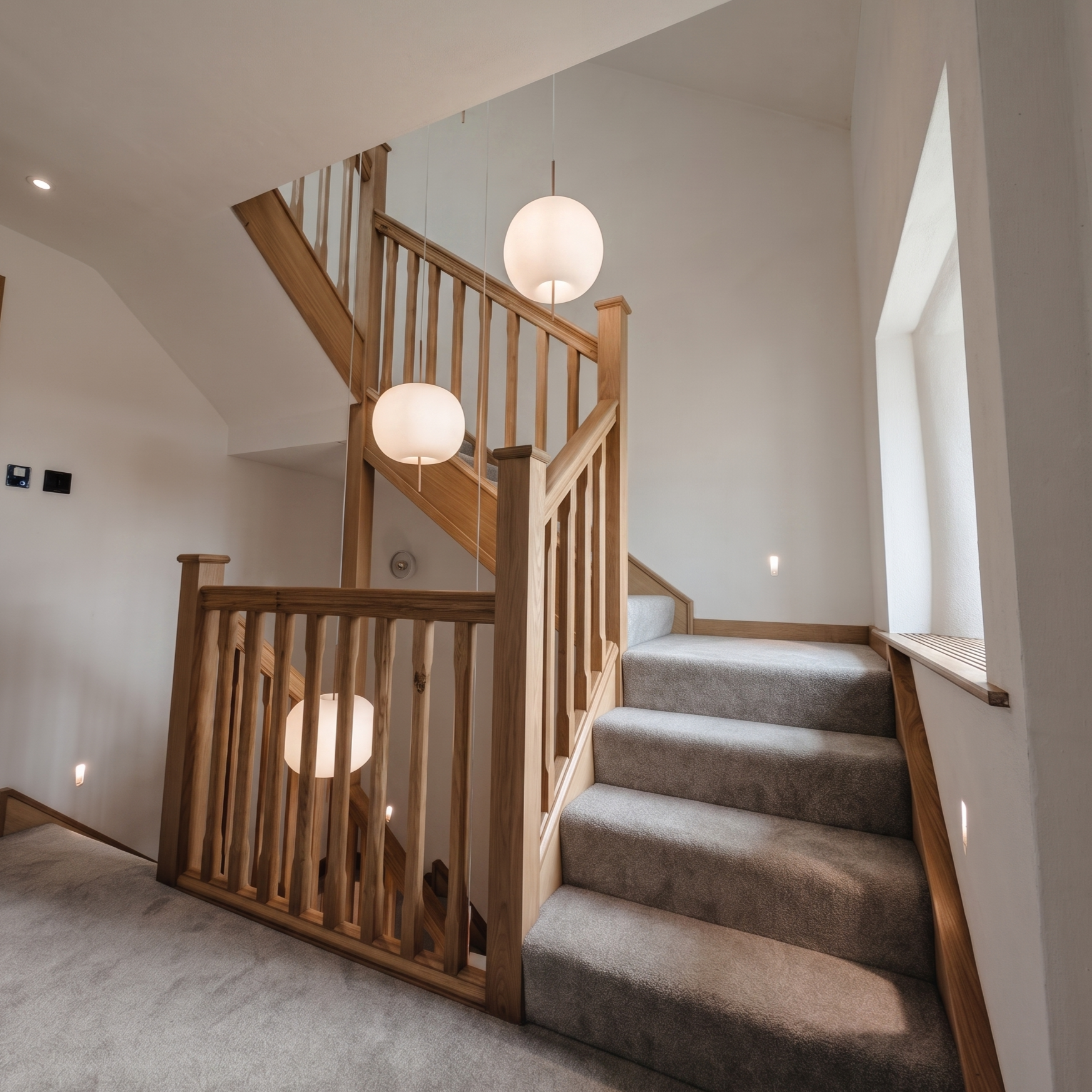
First, we created a new main circulation staircase positioned at the far terminal end of the building. This primary stair provides access to the upper floors and acts as a protected, fire-insulated escape corridor directly to the exterior. Moving the main vertical circulation to this terminal position was a vital architectural maneuver: it satisfied building regulations for safe fire escape routes without requiring heavy, compartmentalizing fire doors on the ground floor. This structural isolation is what uniquely allowed the rest of the ground floor to remain completely open-plan.
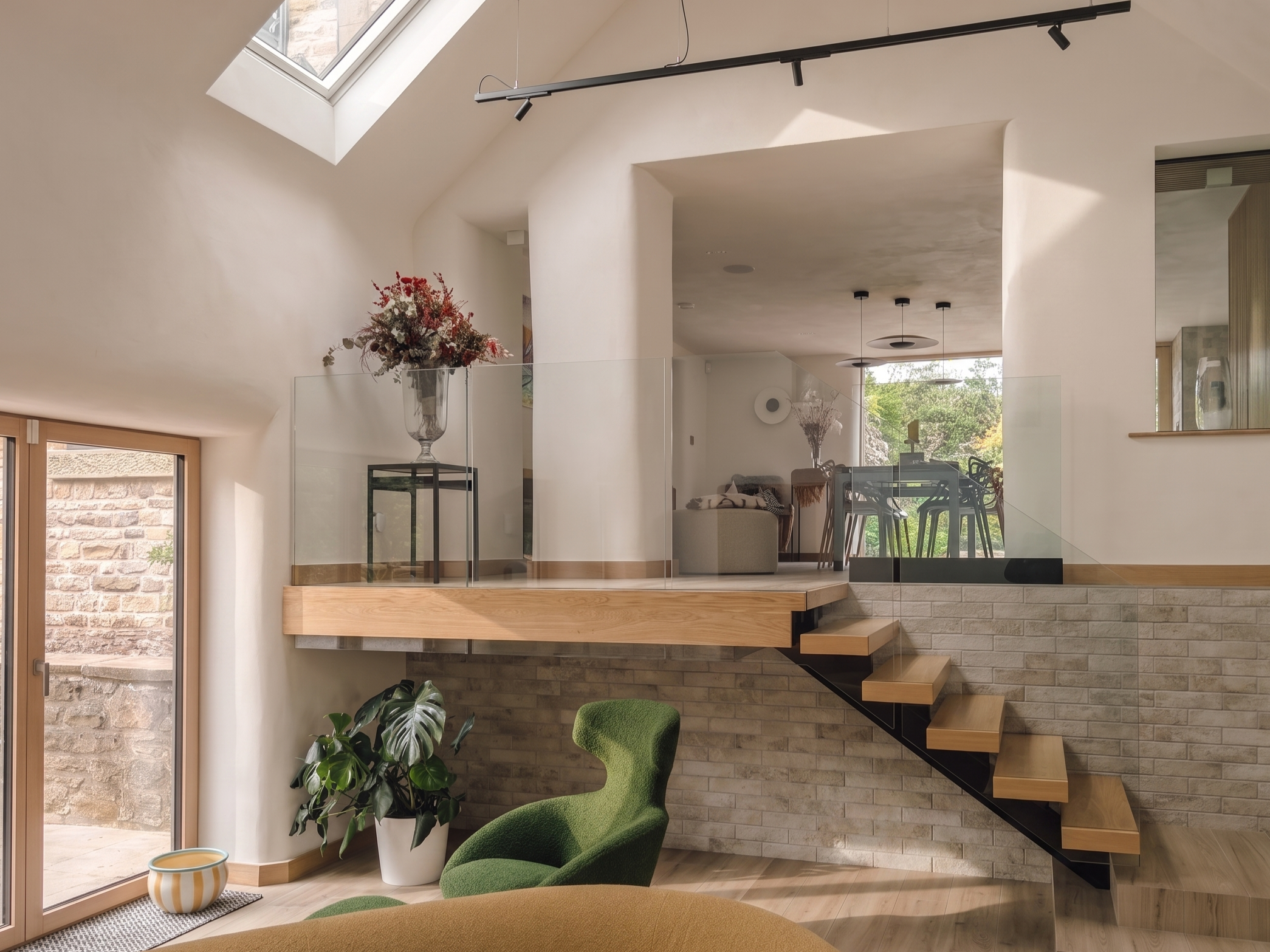
Second, to connect the split-level social spaces, we designed a bespoke feature stair linking the family living room in the lower wing to the main open-plan kitchen and dining area. Engineered by Diomet Fabrications Ltd, this sculptural transition stair effortlessly bridges the 1.2m height gap, turning a historic structural barrier into a natural, open flow of daily family life.
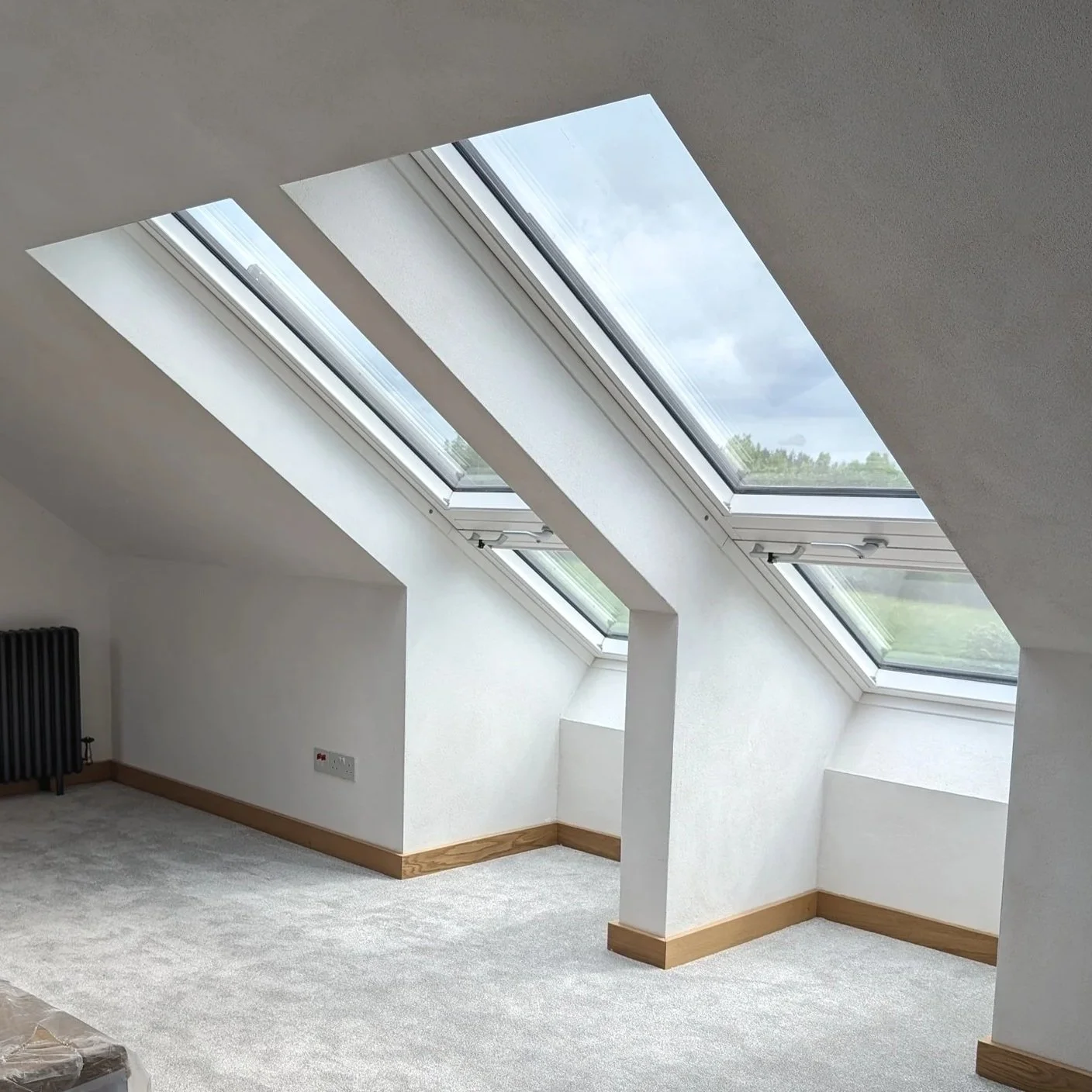
During our virtual BIM walkthroughs, we also modeled how natural light would shift across these newly connected levels. To frame the panoramic Peak District views, we specified triple-glazed timber-aluminum windows and sliding doors from Internorm, supplied and seamlessly installed by ecoHaus SW . To emphasize the dramatic vertical scale of the double-height living room void, we styled it with a sculptural, oversized pendant light, casting delicate, rotating shadows across the warm timber and stone below.
Invisible Intelligence:
Modern Systems in a Heritage Shell
A successful deep retrofit doesn't feel like a science laboratory; it feels like a home. The advanced engineering that keeps Owlet House exceptionally comfortable is designed to run entirely in the background.
Smart Integration: To avoid cluttering the historic gritstone walls with rows of plastic switches, we consolidated the home's infrastructure. Zoned underfloor heating loops, automated lighting scenes, home security, and the mechanical ventilation with heat recovery (MVHR) system are unified into a single, intuitive control system.
Continuous Fresh Air: The home's airtight shell is paired with a Duplexvent Adroit MVHR system specified by Matrix Energy Systems Ltd, which quietly extracts moisture from wet areas, pre-heats incoming fresh air, and reclaims up to 93% of the indoor heat before ventilation.
Effortless Upkeep: Moorland living inevitably brings dirt, mud, and dust inside. To make daily maintenance effortless, we integrated a whole-house central vacuum system. The powerful power canister is isolated in the utility room and piped directly to discreet wall inlets, including a sweep-activated vacuum slot built directly into the kitchen plinth for quick cleanups.
Why This Matters to Homeowners
When upgrading an old stone property, understanding how technical specs translate into real-world comfort is essential:
150mm Breathable Hempcrete: Rather than cold, damp stone, the walls become warm to the touch. Condensation, draft paths, and musty smells disappear, and the house becomes significantly cheaper and easier to heat.
Ground Source Heat Pump (GSHP): Engineered by Matrix Energy Systems Ltd to eliminate oil smell, fuel deliveries, and fluctuating bills. You get consistent, silent, low-temperature underfloor radiant warmth year-round.
93% Heat Recovery Ventilation (MVHR): Continually extracts moisture and stale air, replacing it with fresh, filtered air without losing any warmth in winter.
Measured Performance:
The Proof in the Numbers
The data shows how fabric-first choices directly translate into lowered costs and a healthier carbon footprint:
Annual Carbon Reduction: Achieved an estimated 75.75% carbon saving compared to the home's previous oil boiler and oil AGA, realized by transitioning entirely off fossil fuels to a ground source heat pump and high-efficiency electric appliances.
EPC Transformation: Lifted from a failing, uninsulated G-rated baseline to a D rating. While a D on paper seems modest, standard EPC software penalizes low-carbon electric heat pumps, failing to reflect the home's exceptionally low real-world emissions and running costs.
Heating Demand Reduction: Estimated a 72% reduction in overall annual space heating loads compared to the uninsulated 19th-century gritstone configuration.
Renewable Energy Contribution: The house's ongoing space heating and hot water loads are generated directly on-site, by the in-line solar panels.
What Our Client Says
“Having taken over the farmhouse from my parents, we wanted to preserve the family home but knew living in it through the winter would be incredibly challenging. It was plagued by cold drafts, constant dampness, and the endless worry of oil deliveries. MAD Architects helped us navigate a highly complex Green Belt planning process and transformed the cold, dark barn of my childhood into a warm, bright home that is comfortable to live in year-round.”
Start with a Conversation
Every great project begins with a conversation. If you are planning an extension, renovation, eco-retrofit, or new build in Sheffield, we would love to hear your ideas.
Complete our simple online form
Discovery Call:
We will arrange a complimentary 15-minute call to discuss your vision.Feasibility & Concept Session:
A dedicated workshop where we explore the full potential of your property, producing initial sketches and a clear project roadmap.

Project FAQs:
Inside the Owlet House Retrofit
To provide insight into the unique engineering, heritage, and planning strategies applied during this project, we have compiled answers to the most common questions:
-
Solid 19th-century gritstone walls rely on vapor permeability to dry out. Standard non-breathable insulation like PIR boards traps moisture inside old stone, creating a direct path for structural dampness and timber rot. We sprayed 150mm of natural hempcrete directly onto the stone because it acts like a breathable winter coat, allowing moisture to escape naturally while making the walls warm to the touch.
-
Old farmhouses are notoriously drafty, which typically makes low-temperature heating systems like heat pumps perform poorly. Our solution was a "fabric-first" sequence. Matrix Energy Systems Ltd installed a five-kilometer underground loop array in the adjacent field, but its efficiency was entirely unlocked by our thermal envelope upgrade—lowering the farmhouse's space heating demand by 72% so the low-temperature GSHP can effortlessly maintain warmth.
-
No. Although there were strict Green Belt and Dore Neighbourhood Plan Area rules, we secured planning relatively straightforwardly by taking a proactive approach. Situated in a highly protected buffer zone, the project was indeed subject to strict guidelines—including Sheffield City Council's 33.3% volumetric expansion limit. However, by retaining the main structures, routing geothermal services entirely underground, and managing stormwater naturally through subtle biodiversity ponds, we navigated the requirements smoothly to secure approval (Ref: 21/00965/FUL).
-
We fully preserved the historic 19th-century gritstone outer shell and primary structural footprint. The layout inside was completely reorganized to unify the original cellular spaces. However, upon structural stripping, we found severe wet rot decay in the roof timbers due to past poorly ventilated repairs, requiring a complete, high-performance structural replacement of the roof trusses.
-
Standard UK Energy Performance Certificates (EPCs) use a generic methodology that penalizes grid-connected electricity (used by the heat pump) and fails to model the moisture-regulating, insulating properties of dynamic heritage materials like hempcrete. While the home officially registers a 'D' on paper, its real-world performance is exceptional, delivering a 75.75% estimated carbon reduction and a 72% space heating demand reduction.
-
The original barn and farmhouse floors sat on an awkward 1.2m split level, disrupting family life. We consolidated the floor heights by forming a unified open-plan kitchen and dining hub on the ground floor, connected back to the family living room in the lower wing via a sculptural, floating oak and steel central-spine staircase engineered by Diomet Fabrications Ltd. To preserve this open-plan flow and avoid unsightly fire door lobbies, we relocated the primary vertical circulation staircase to the terminal end of the building, creating a protected fire escape corridor.
-
Absolutely. This fabric-first retrofitting and planning sequence is the blueprint for converting traditional stone barns, farmhouses, and Green Belt properties across South Yorkshire and the Peak District fringe into high-performance homes.
Common Concerns We Hear
Older stone properties and Green Belt planning restrictions present unique challenges. Here is how we help clients address the most common worries:
-
Probably, but it is rarely a straightforward process. While Green Belt policy is highly restrictive, extensions and barn conversions are achievable when designed with careful planning strategies. The key is demonstrating a detailed understanding of strict volume limits (such as the 33.3% volume limit in Sheffield) and creating highly efficient designs that work with the original scale.
-
Traditional solid-wall buildings must be treated with care. Using standard modern cavity insulation or vapor-impermeable plastics can trap moisture inside the stone, leading to rotting timbers. We prioritize vapor-permeable, breathable materials like spray-applied natural hempcrete, which insulate the stone while letting the building dry naturally.
-
We manage planning risks proactively. Our initial Feasibility & Concept session identifies planning opportunities and roadblocks early on, ensuring we develop a strategy aligned with local policies before you invest in deep technical design.
-
Yes, but only if you take a "fabric-first" approach. Installing a heat pump in an uninsulated stone building is highly inefficient. By insulating the walls with hempcrete and installing triple glazing, we lower the heating demand of the building so that low-temperature radiant underfloor heating can run highly efficiently.